
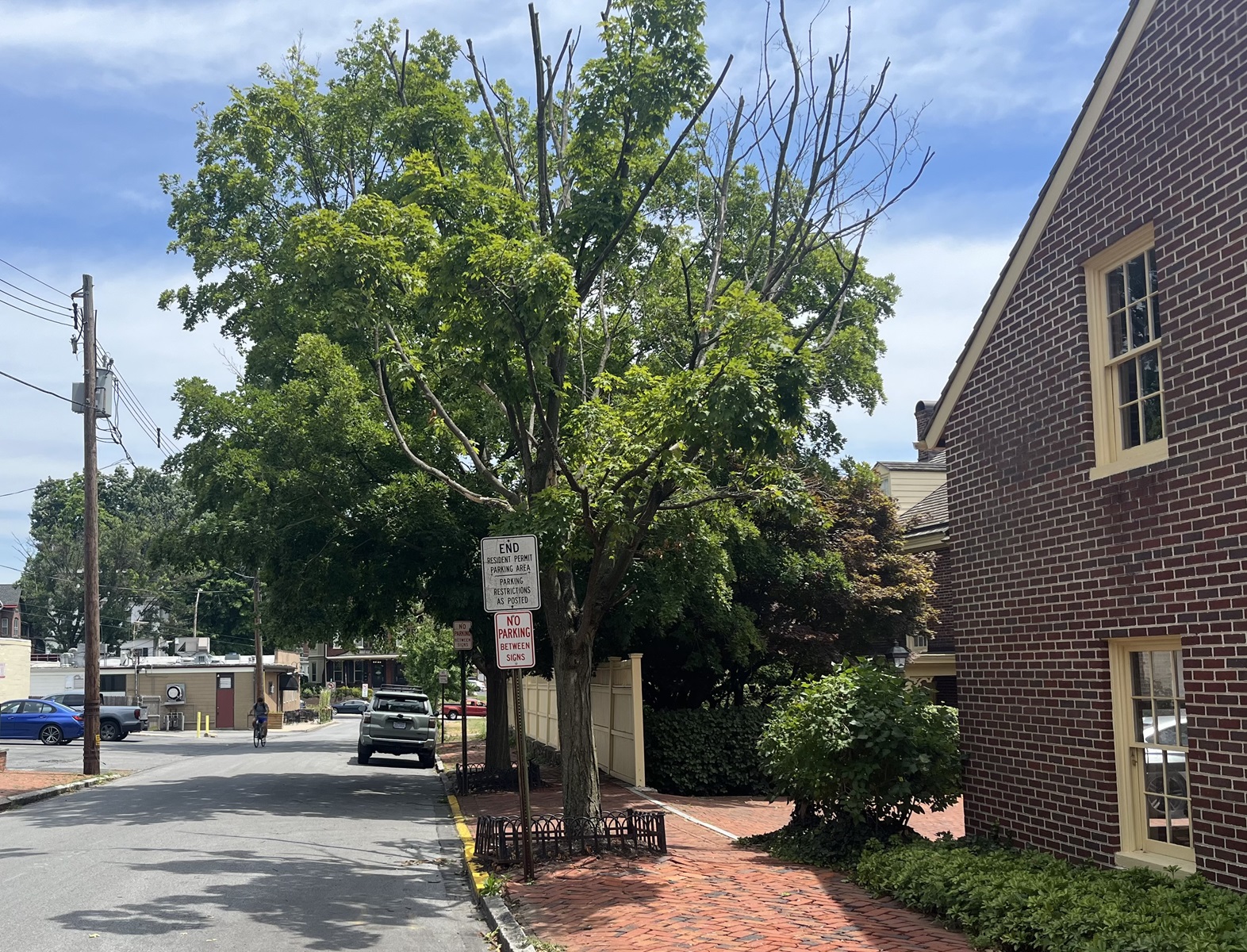

No, this is not going to be another rehashing of how the Borough has 2000 permitted residential parking spaces for roughly 5000 issued permits (resident and guest). That is an old stat anyway and I am sure much has been done (fingers-crossed) in the last six years to close that gap – but again this is NOT an article about that. This article pertains to parking problems yet to come.
In 2021, West Chester updated its Zoning Code. One of the changes made regarded how parking is calculated for new developments. Instead of relying on a set number of spaces for a set number of units as it did in the past, the Zoning Code now requires each developer to calculate their projected needs and then validate those needs using an independent parking study. The idea was that customized plans would meet the building’s actual needs better than a one-size-fits-all approach. As the chart shows, the request, while rational on paper, has led to a potentially significant under-sourcing of parking spaces.

The problem it seems lies in how you view life in the Borough. By sheer numbers, West Chester is a tight squeeze. It has a population density of 10,114 people/sq mi putting it in arm’s length of some of the country’s densest cities. For example, Philadelphia has a population density of 11,936 people/sq mi, Washington, D.C., 11, 535 people/sq mi, The Borough far exceeds the density of many of the country’s smaller cities like Seattle (7,962 people/sq mi), Houston (3,598 people/sq mi), and Pittsburgh (5,471 people/sq mi). But while we might be urban-level packed, we lack much of a city’s infrastructure, particularly regarding public transit and/or walkable access to life-sustaining things like jobs and grocery stores.
With these nuances in mind, it is now believed traffic studies relying on the “dense urban” categorization, while perhaps technically correct, greatly underestimated the complexes’ actual parking needs. “There is a definite gray area here,” admitted Planning Commission member Allen Burke who helped lead the commission’s efforts to revise the standards.
To “right size” as Borough Councilwoman Nicole Scimone put it at last week’s Borough Council meeting, the Planning Commission has proposed reinstating firm parking requirements.
Under the proposed modifications developers would need to allocate 1.2 parking spots per one-bedroom apartment or studio, 1.7 spaces for a two-bedroom unit, 2.2 parking places for a three-bedroom, and 2.5 spaces for a four-bedroom unit. This amounts to a compromise between 2012 parking standards, those used when Chestnut Square was built, and the 2021 update. There are reports that Chestnut Square regularly has unused spaces indicating the parking requirements at the time were too robust.
Last week Borough Council voted to accept the proposed revisions. The new parking requirements are now with the Borough’s solicitor who will make the official changes to the Zoning Code. The revised code is expected to be presented at next month’s Committee meeting at which time Borough Council wil schedule a public hearing on the matter.
So what’s the damage? Well, that is TBD. The current calculations were used on 250 E. Market St. (Rubenstein’s), 330 W. Market St. (Mitch’s) and 410 S. High St. (Burger King). Since none of these are built yet, it is impossible to know the full impact – maybe Gen Z really will stay away from cars, but, just in case they don’t, Council and the Planning Commission are eager to get the new rules in motion before any new development plans are submitted.
It’s important to note that residents in these developments can not request residential parking permits. This should help keep cars off permitted streets but it will likely add volume to nonpermitted areas like those on Miner St.
Originally published on June 28, 2024
This story was part of a longer West Chester newsletter featuring all the news and events of the week. Curious what else is going on? Subscribe now to get the full story. New issues come out on Fridays!

Leave a Reply