
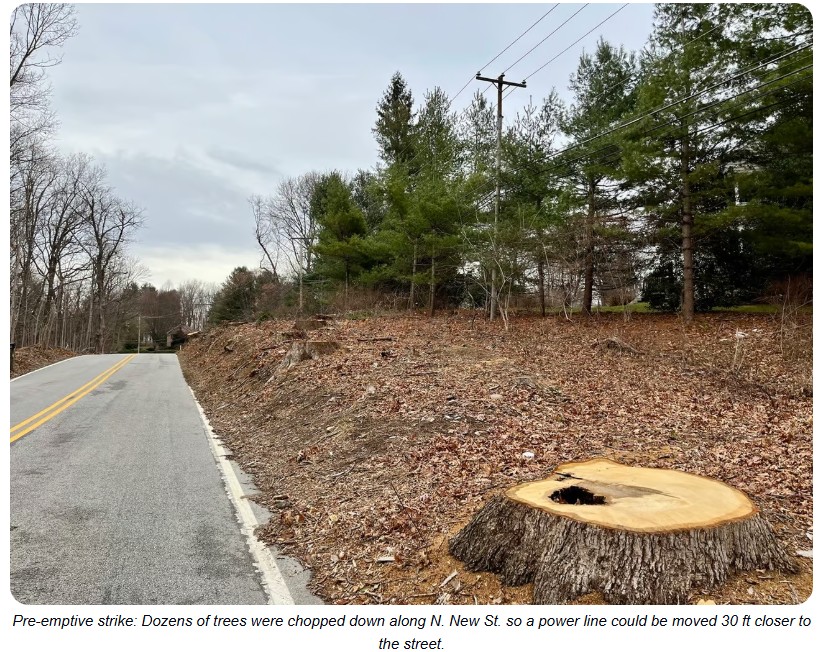

Last year, I shared that PECO had razed dozens of trees along N. New St. in order to improve powerline accessibility. West Chester lawyer Stanley J. Lieberman is back to explain how this can happen and why residents are virtually powerless to stop it.
On October 14, 1066, at a huge field in Hastings, Southern England, a man known as The Duke of Normandy, William the Bastard to his friends, defeated the home-town Anglo-Saxon army. There followed some lesser battles and on Christmas Day, 1066 William became William I, King of England, also known as William the Conqueror.
William received the ultimate gift that Christmas – he now essentially owned all of England. And the seeds of what would evolve into the concept of Eminent Domain were planted.
Teh Gift that Keeps on Taking
But William had a problem. Neither the Welsh, the Scots, nor The Danes were happy with William’s victory. He had to defend all of England if he was to continue as King. Obviously, this task was too big for one man. So, he assembled all of his loyal followers, each of whom had provided a part of his conquering army and proceeded to give them all the rank of Duke, the highest rank below the King’s family.
Then he gave each of them the use of gigantic areas of land in the major, strategic parts of England. This was their respective Dukedom. But he did not give them full ownership. William retained outright ownership. The appointed Duke had to build a castle, defend the land, and build a town. He could grow crops, raise livestock, harvest timber, and do whatever else he wanted to raise revenue. He had to send the King a portion of the income every year. And, most importantly, raise an army to send to the King when ordered. So long as the appointed Duke followed these rules, he could pass his Dukedom to his first-born son.
Remember William’s Christmas gift. He was “Eminent,” that is standing above all others in rank. And England was his “Domain,” a territory controlled by a ruler.
Modern Day Consequences

Fast forward to the 21st Century. Today Eminent Domain gives the right to the government, and others to take private land for public use. Wait! What? Who are these “others” and what does it mean to “take” and what is “public use?”
We know who the “government” is – but who are these “others?” Utility companies have acquired the right of Eminent Domain. Over the decades they have fought many legal battles and convinced the courts that when they take land for power lines to deliver electricity to sell, or to deliver water to sell, it is for public use. This also applies to PennDOT when they create a new road or widen an existing road. And to the public school district when the high school wants to build a new stadium or a new school building.
If it is a division of government, public utility, public school district, or other entity that qualifies, there is usually no challenge to the “public use” aspect. This concept has been refined over decades of court cases so it is usually clearly spelled out in the Notice of Condemnation. But it is not absolute and not a slam-dunk for the condemnor. There is a major appellate court case where a municipality tried Eminent Domain to obtain a large parcel for a shopping center. The court said a shopping center is not “public use” and denied the condemnation.
Notice of Condemnation
What does it mean to “take?” Fortunately, if they “take” they have to pay. The procedure is to serve a Notice of Condemnation on the property owner. The Notice describes the property to be taken and, as a Constitutional guarantee, must contain the offer of “just compensation.” This amount may not be acceptable to the property owner. There are three levels of increasingly complex and costly legal procedures available to the property owner to obtain a higher compensation.
The good news is that Eminent Domain was the procedure used by various government agencies to obtain almost every National Park and similar property.
Which brings us to the tree removal on North New Street. That was done by a public utility, lawfully in accordance with the required procedures, to improve the electric grid and therefore as a public use. While not aesthetically pleasing, it was legal.
A special thank you to Stanley for sharing his legal knowledge so we all have a better understanding of the process. Want to know more? Read his explanation of Zoning Codes.


Leave a Reply