
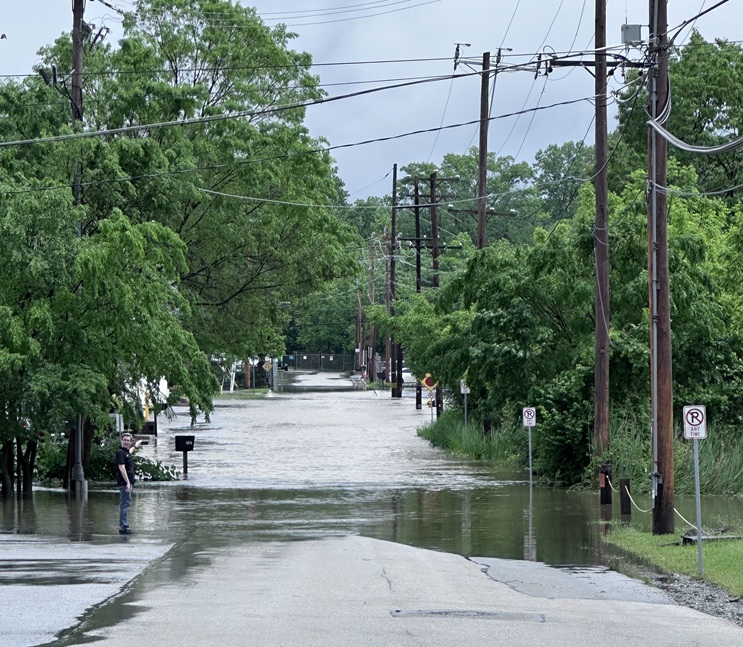

Photo: Courtney Finneran
Last Friday, West Chester Borough had an extreme version of what has become a rather regular occurrence: the east side flooded. After an hour of intense rainfall, Gay St. was left impassable, while Montgomery Ave. and Franklin St. resembled rivers with flood waters rushing through and stranded vehicles sitting like rocks mid make-shift stream.
Why does this keep happening? According to Goose Creek Alliance President Mike Dunn, the problem actually dates back to the earliest farming cultures and their ill-conceived use of mill dams to grind that grain. These dams buried the natural floodplains and led to a buildup of sediment. Of course, allowing developers to build on top of Goose Creek didn’t help either. So, while on most calm days the water flow manages along as a small stream, it remains a body of water looking for a streambed. Which is exactly what it did on Friday.
So, what can we do about it? Well, here the answers are far from simple. Returning the area to its natural form seems to be out of the question. So what is left is a hodgepodge of solutions, often checked at the township border, each hoping to abate a bit more of the problem. West Chester Borough has installed rain gardens and bioswales. Meant to slow and filter the water during periods of moderate rain, it’s hard to imagine their presence was even acknowledged by Friday’s gushing flows.
Muncipal Solutions
West Goshen, with the aid of a $700,000 transportation grant, is beginning a more ambitious project this year. The township wants to replace the current storm pipes under Montgomery Ave. with twin 4 ft. x 10 ft. box culverts and headwalls. The 18-month project, once completed, will provide a significant increase in flow capacity for the stream. Still, likely not enough to deter the entirety of the flooding we saw last week. As engineers told township supervisors when they first presented the project last summer, only a bridge can do that.
This week, I spoke with Mike about the situation. Earlier this spring, his organization released a Watershed Action Plan, a comprehensive plan to restore the Goose Creek watershed utilizing best management practices. The goals of the plan are to improve ecological function and water quality, as well as reduce flooding.
HWC: Give it to me straight – are we beyond hope? Should we give up on the watershed and embrace the flooding?
MD: I can tell you that caring for our watersheds isn’t optional — it’s essential. Friday’s cloudburst storm (1.89 inches in 1 hour!) showed us that upstream watersheds like Goose Creek are the lifeblood of our communities. They supply our drinking water, protect us from flooding, support wildlife, and ultimately flow into larger rivers and bays that impact the health of entire ecosystems.
HWC: Speaking of that scope, we’ve spoken in the past about the need for a plan that looks at the entire area regardless of who governs it. Does this plan do that?
MD: Yes, that’s exactly what makes this plan different—and why the Goose Creek Alliance strongly supports it. For too long, efforts to restore and protect Goose Creek have been piecemeal, constrained by municipal boundaries that don’t reflect the way water actually moves through the landscape. Water doesn’t stop at a township line. Neither should our solutions.
This plan looks at Goose Creek as a whole system—its headwaters, tributaries, floodplains, and wetlands. It prioritizes actions based on what will have the greatest long-term benefit across the entire area. It brings municipalities, landowners, nonprofits, and agencies to the same table, recognizing that collaboration is the only way to make real progress.
HWC: So, how do we go about implementing solutions that may require participation and, more importantly, money from more than one municipality?
MD: That’s a critical question—and it’s where collaboration and strategy come together. The reality is, no single municipality can restore the Goose Creek watershed on its own. But what they can do, together, is leverage shared priorities—like flood reduction and regulatory compliance—to drive collective action and unlock funding that benefits everyone.
Every municipality in the Goose Creek watershed has a regulatory responsibility under Pennsylvania’s MS4 (Municipal Separate Storm Sewer System) program to reduce pollution and manage stormwater runoff.
The Goose Creek Alliance is working to align MS4 requirements with high-impact ecological projects, particularly floodplain restoration. Restoring floodplains naturally filters pollutants, slows down stormwater, and improves water quality. All of this counts toward MS4 credits. Beyond compliance, these projects also reduce flooding, improve habitat, and make our communities more resilient.
Ongoing updates to MS4 requirements have improved the framework for intermunicipal collaboration. Municipalities like the Borough of West Chester, which have limited access to high-priority stream restoration frontage within their jurisdiction. They can now partner with neighboring municipalities that possess more viable restoration sites.
Through formal agreements, they can jointly implement best management practices and equitably share pollutant reduction credits. This cooperative approach stretches every dollar for a higher return on investment. It increases MS4 compliance returns, and delivers measurable water quality and flood mitigation benefits across the broader watershed.
HWC: If I’ve learned anything following stormwater management plans, stream protection is complicated and costly. In your opinion, what is the most important thing the GCA can do for our watershed?
MD: We’re not asking municipalities to go it alone. The Alliance is here to help! Our team of industry professionals can coordinate, write grants, and manage partnerships so that everyone sees a return on investment—in cleaner water, reduced flooding, and a healthier Goose Creek for generations to come.
Thanks, Mike! With the Watershed Action Plan in place, the Goose Creek Alliance is now working towards its first shovel-ready project. If you would like to support their efforts, they are seeking board members and donations. Take your pick.
This story was part of a longer West Chester newsletter featuring all the news and events of the week. Curious what else is going on? Subscribe now to get the full story. New issues come out on Fridays!

Leave a Reply